

4-Oxo-4H-quinolizines (quinolizinones), 4-oxo-4H-pyrido[1,2-a]pyrimidines, and related fused pyrimidones (azaquinolizinones) are important and useful scaffolds for applications in medicinal chemistry, catalysis, and materials science. In contrast to the well-studied bioactivities, other properties and applications of (aza)quinolizinones are still poorly explored and should be exploited. Aryldiazonium salts are versatile intermediates in organic synthesis, often used for the arylation of organic compounds by nucleophilic aromatic substitutions, cross-coupling and Sandmeyer reactions, and photocatalytic transformations. In this context, we previously (2000–2008) reported the synthesis and thermal transformations of stable (aza)quinolizinyl diazonium tetrafluoroborates. Since 2022, we study the photochemical transformations of title diazonium salts to obtain novel 3-substituted (aza)quinolizinones with interesting properties (bioactivity, fluorescence, etc.) in an environmentally friendly and sustainable manner. So far, C–H arylation and sulfanylation methods were developed, while other possible photocatalytic transformations of title diazonium salts are to be tested as well.
Chemical modification of proteins is a key technique in bioconjugation that allows various synthetic molecules, such as fluorescent dyes, affinity markers, NMR/MRI probes or cross-linking reagents, to be covalently bound to proteins. Due to known applicability of aryldiazonium salts in bioconjugation, we are exploring the application of title diazonium salts as readily available reagents for selective bioconjugation and fluorescent labeling by targeting specific side-chain functional groups of different amino acids in proteins. Recently, the proof-of-concept was demonstrated by the successful binding of (aza)quinolizinyl-diazonium to the bovine serum albumin (BSA) protein under photocatalytic conditions, with the luminescent properties of the (aza)quinolizinyl residue allowing easy detection and quantification of the obtained bioconjugates. Further studies are underway to determine the substrate (protein) scope and site-selectivity of bioconjugation with (aza)quinolizinyl diazonium salts.
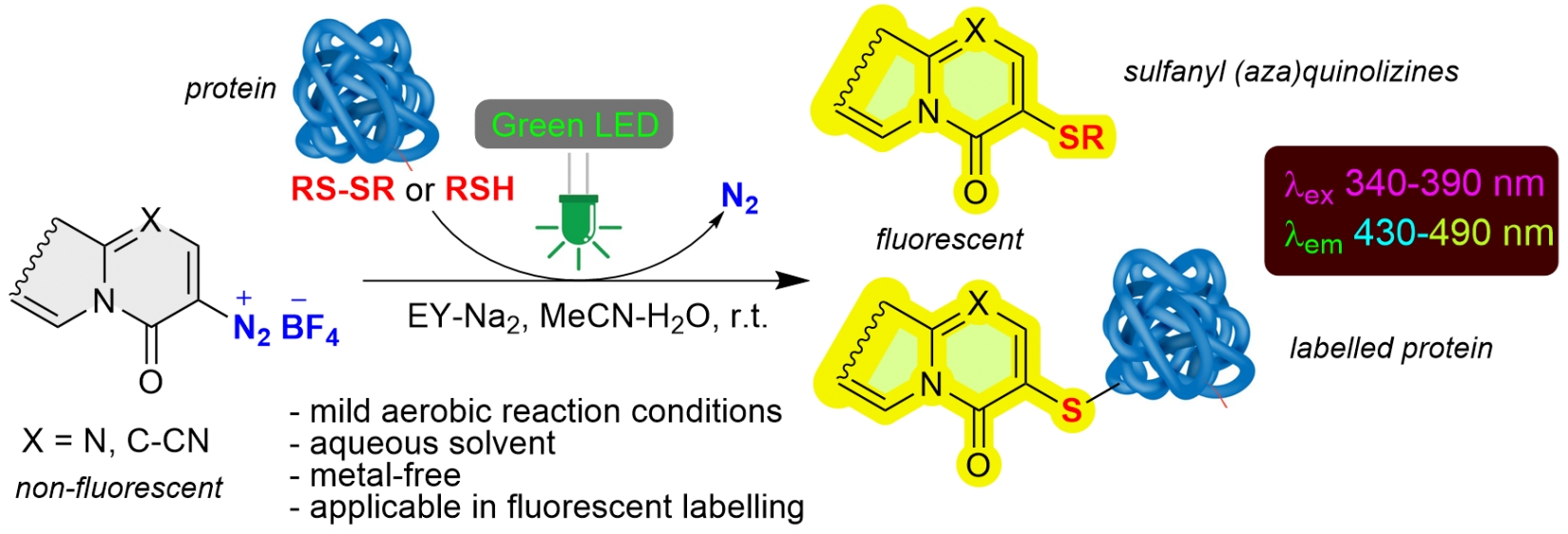
Application of (aza)quinolizinyl-3-diazonium tetrafluoroborates in photocatalytic sulfanylation and in fluorescent labeling of proteins.
![<p>Catalytic Photoredox C–H Arylation of 4-Oxo-4<i>H</i>-pyrido[1,2-<i>a</i>]pyrimidine-3-diazonium Tetrafluoroborates and Related Heteroaryl Diazonium Salts.</p>](/upload/gallery/big/32.jpg)
Catalytic Photoredox C–H Arylation of 4-Oxo-4H-pyrido[1,2-a]pyrimidine-3-diazonium Tetrafluoroborates and Related Heteroaryl Diazonium Salts.
![<p>Synthesis, structure, and optical properties 3-(1<i>H</i>-1,2,3-triazol-1-yl)-substituted 4<i>H</i>-pyrido[1,2–<i>a</i>]pyrimidin-4-ones and 4<i>H</i>-quinolizin-4-ones.</p>](/upload/gallery/big/33.jpg)
Synthesis, structure, and optical properties 3-(1H-1,2,3-triazol-1-yl)-substituted 4H-pyrido[1,2–a]pyrimidin-4-ones and 4H-quinolizin-4-ones.
